Thank you for visiting the Dajan website. For any feedback or info mail us at info@dajan.it

WH FEED-THROUGH PRODUCTS
Capillary tubes can be inserted in the well bore, either in the annulus or in the tubing, to achieve different type of purposes like gas lift, chemical injection, PCP/ESP completions or de-watering.
When in need to work over a well to install a capillary system, the first concerns are related to the topside and wellhead modification requirements.
Dajan provides SCSSV and penetrator ready to use solutions that can be use for capillary workover both for solid umbilical or Fluid/Gas path systems.
The Well Head (WH) feed-through allow wellbore access with minimal disruption. It has been designed for all semi-permanent Chemical Injection installations, both onshore and offshore.
Historically, semi-permanent Chemical Injection Installations have not been considered safe, practical or economically viable due to the necessity for serious disturbance to existing topside infrastructure. To date the following two options have been utilised:
-Installation of a second BOP or double barrier pack-off on top of the Christmas tree, resulting in isolation of the upper and lower master valves, compromising safety.
-Installation of a spool piece or Y-block arrangement below the Christmas tree, resulting in flow line adjustments and great expense with significant down time.
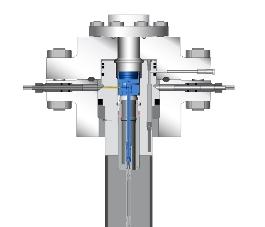
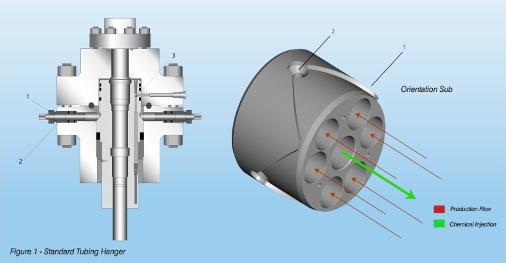
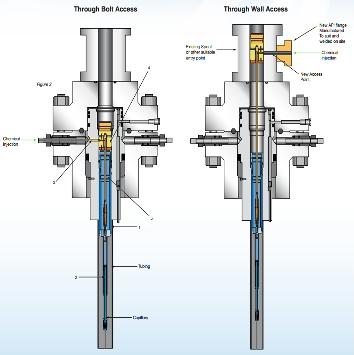
The WH feed-through provides communication, via a hollow tubing hanger tie down bolt, through a sub landed in the tubing hanger profile.
For offshore applications the system is generally used in conjunction with a Torus Insert Safety Valve configured for Capillary installations.
A hot tapping operation is carried out through a tubing hanger tie down bolt to provide a communication path into the well bore.
A Lock mandrel with a stinger and capillary slip joint, is then landed in the Tubing Hanger Plug Profile.
An insert tie down bolt is installed as an orientation pin, protruding into the well bore. Finally the Capillary Coupling Sub (CCS) is run in hole.
The insert tie down bolt orientates the CCS rotationally and linearly before it latches into the CLM. The tie down bolt is then extended into the injection port on the CCS, completing the injection path.
 Retrofit Installation
Minimally Invasive
No major modifications to existing surface infrastructure
Don’t need to lift tree
Don’t need to move flow lines
Full tree functionality maintained
No need to kill the well
Maintain full independent integrity of wellhead barriers
DNV verified and approved
Barriers fully tested and qualified prior to installation
Wellhead suppliers acceptance and cooperation
Injection point and isolation valves separated – failure of one does not affect the other
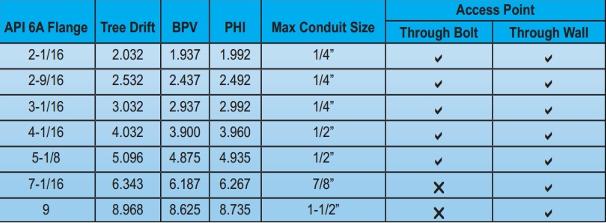
Select any size of injection umbilical for multiple applications – foamers, chemical injection, gaslift